

How AI Is Transforming Website Design and Game Development

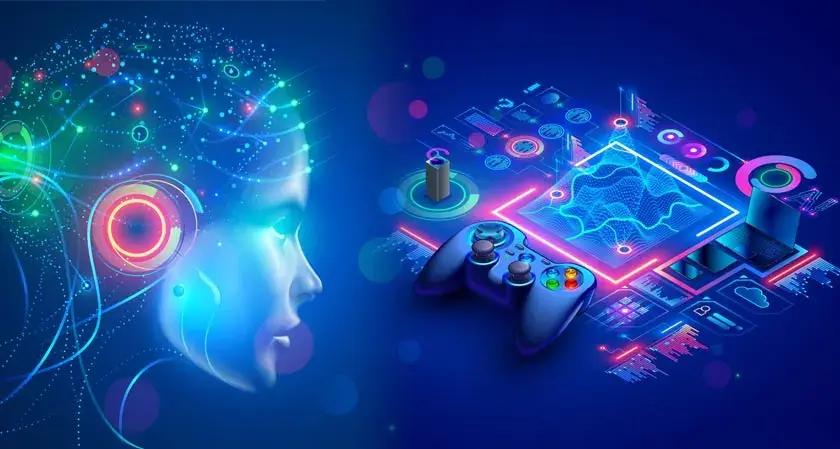
How AI Is Completely Changing the Way Humans Design Websites and Create Games
For more than 20 years, building a website or developing a video game has always been considered the job of “technical people”: programmers, software engineers, designers, and technical artists. But since artificial intelligence (AI) entered its explosive growth phase, that boundary has been collapsing faster than anyone ever imagined.
Today, a person with no coding knowledge can still create a fully functional website. Someone who has never studied game design can still make a game with gameplay, characters, maps, and mission systems. All of this is made possible by AI.

From Hand-Drawn Sketches to Automated Websites
In the past, the process of creating a website was quite complicated. You had to draw layouts, choose colors, select fonts, and then a developer would convert them into HTML, CSS, and JavaScript. Every small change took time.
AI has completely reversed this process. Now, you only need to describe: “I want a game-download website with a dark interface, a tech style, and a prominent download button” — and AI can generate a complete design and the corresponding source code.
It does not stop at the interface. AI also understands:
- Page structure
- User behavior
- How to arrange content for easy use
- Load-speed optimization
This turns website design from a technical task into a purely creative process.
AI Is Becoming a “UI/UX Designer”
Modern AI models can analyze millions of existing websites and learn what makes a good interface and what creates a proper user experience. When you ask AI to create a website, it does not just “make it look nice” — it designs it according to real-world usage logic.
For example:
- Important buttons are placed in easy-to-click positions
- Colors have good contrast for the eyes
- Menus are clean and easy to understand
This makes AI a virtual UI/UX designer that works 24/7.

AI Is Transforming the Game Development Industry
If websites are the gateway to the Internet, then games are the heart of the digital entertainment industry. And AI is moving deep into that heart.
In game development, AI does not only help write code — it also directly participates in the creative process:
- Creating characters
- Drawing environments
- Building maps
- Generating quests
- Balancing gameplay
A game that once required dozens of people can now be made by a very small team — or even a single person — with the help of AI.
Characters, Worlds, and Stories Generated by AI
AI can create hundreds of different characters in just a few minutes, each with:
- Unique appearances
- Unique personalities
- Unique backstories
For open-world or role-playing games, this is a revolution. Instead of manually designing every NPC, game developers can use AI to generate entire virtual societies.

Gameplay and Game Rules Are Also Supported by AI
Not only graphics, AI also takes part in the “brain” of a game. It can help design:
- Skill systems
- Levels
- Difficulty
- How enemies react
AI can simulate thousands of playthroughs to find the most balanced gameplay, something that would take humans months of testing.
The One-Person Studio: A New Trend in Games and Web
When AI handles most of the technical and design work, humans can focus only on ideas and direction. This is creating a new trend: the one-person studio.
A single individual can:
- Use AI to design websites
- Use AI to program the backend
- Use AI to create games
- Use AI to build interfaces
What once required an entire team now only needs one creative mind.

The Future of Web and Games Will Never Be the Same
In the next 5–10 years, knowing how to code will no longer be a major barrier. Instead, the ability to describe ideas clearly for AI will become the most important skill.
Websites will be created faster, look better, and be more tailored to different user groups. Games will have larger worlds, more diverse characters, and more flexible gameplay.
AI does not take away human creativity. It amplifies it.
Conclusion
AI is turning website design and game development from technical work into a purely creative form. When machines handle the heavy lifting, humans are free to focus on what matters most: ideas and experience.
This is not a distant future. It is happening right now.
